

In 1993, National Review magazine printed an article by Digby Anderson, a conservative British writer. The article was called “Lost and Found.” Ostensibly, it was a review of William Bennett’s Book of Virtues, a best-selling compendium of traditional moral writings for children.
But it was more than that.
He talked of coming across an old copy of Baroness Orczy’s Scarlet Pimpernel and of the pleasant memories it brought back from boyhood. He bought it and read it again, “expecting to find it nonsense.” But after reading it, he said, he felt something quite different.
“It is not nonsense,” he said. And then, he added, a funny thing happened:
Slowly the names started coming back: not just Baroness Orczy but Rider Haggard, Anthony Hope, Rafael Sabatini, G. A. Henty, Harrison Ainsworth, Conan Doyle, C. S. Forester, John Buchan, P. C. Wren, Percy Westerman, and a dozen others.
He began to re-collect the books and the authors that inspired him as a boy. It was apparently difficult, since most of them were no longer in print and expeditions to obscure bookstores to find them slowed the process—and, in addition, didn’t comport well with his sense of dignity (or cleanliness):
Of course, you can find them if you are prepared to visit countless bookshops and sift through the filth and inanity that fill them—and the unpleasant people one finds in bookshops these days.
Apparently no one was there to hand him a wipe. But it was still worthwhile, despite the indignities involved in the effort: “Ten years later,” he said, “I have them, in a tall Victorian bookcase, eight shelves entirely filled with reactionary novels.”
He didn’t mean “reactionary” in any political sense. In fact, there is little overtly political about these books. These are books, however, which seemed to have lost the confidence of publishers and librarians, partly because of anachronisms in the language, but even more because of the unapologetically masculine portrayals of the heroes in the stories.
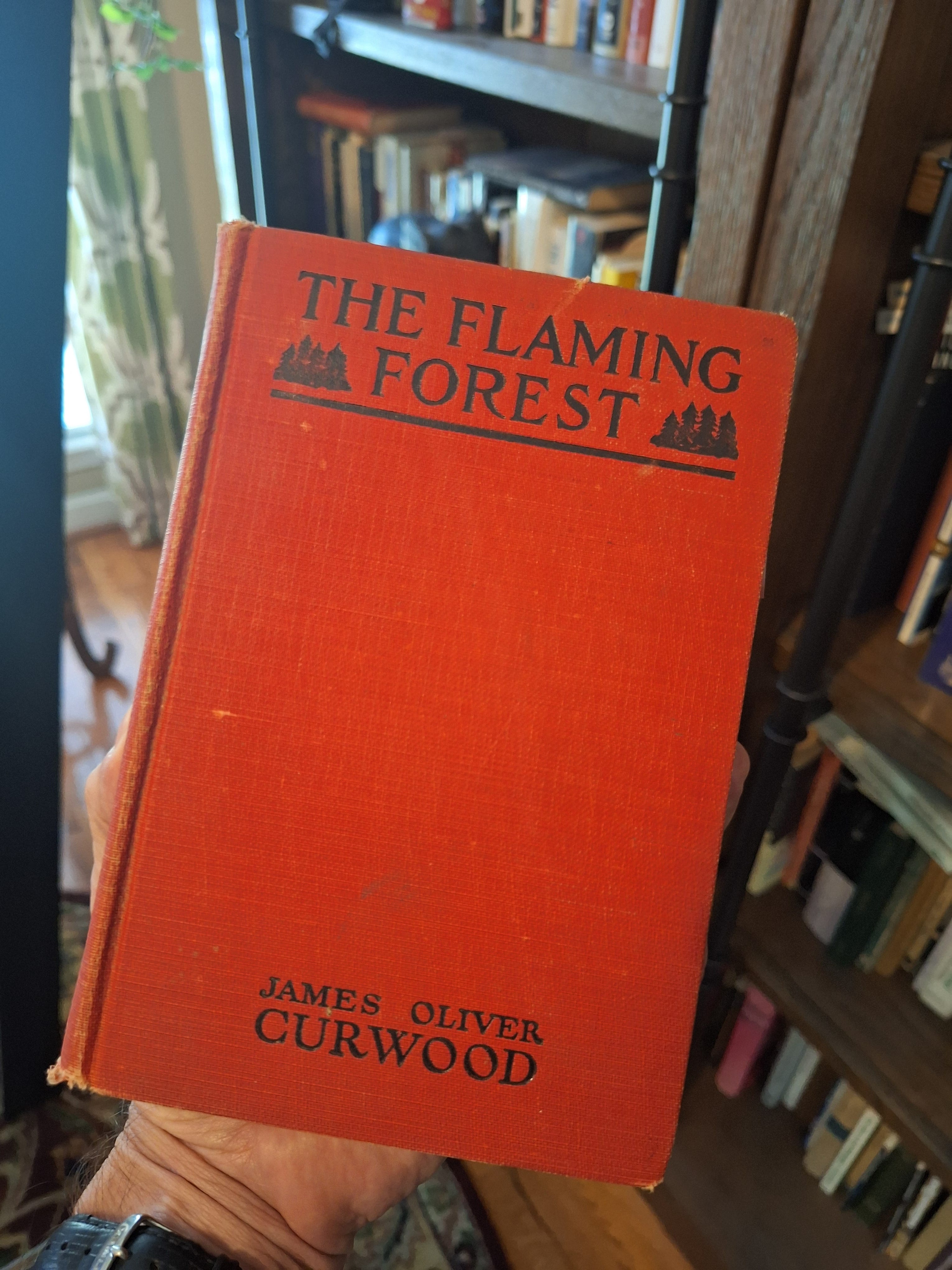
After reading the article, I started to look for these books myself. I too made expeditions to used book stores, searching for these lost classics for boys. Some of them were easy to find. Louis L’Amour westerns are all still in print, and widely available in any used bookstore in previously-owned paperback form. Edgar Rice Burroughs, he of Tarzan fame, also are not hard to come by. But others can be found only through bibliophilic archeology. One occasionally comes across an old H. Rider Haggard novel, usually King Solomon’s Mines, or She: A History of Adventure. Sometimes one discovers an old Raphael Sabatini novel, more likely than not one of his pirate stories. And one can occasionally find one of Johnston McCulley’s original Zorro stories, which some still remember thanks to the Disney television series of the 1960s. But James Oliver Curwood’s The Valley of the Silent Men? Or P. C. Wren’s Beau Geste, which was made into a classic movie (which also had the benefit of a hugely popular 1936 movie starring Gary Cooper)? Or The Prisoner of Zenda, by Anthony Hope, also made popular by Hollywood? They are nowhere to be found.
I scoured the shelves of many of these stores, searching for these treasures, and I found a few. And the more I searched—and researched—the more I found. This was in the 1980s, when the word “online” was used only by people who worked on big computers (the only kind there were). Later, when this thing called the “internet” came along, I found even more. I found enough to stock my own reactionary bookcase, several of them, in fact. I have now filled them with books by the authors Anderson mentioned in his article, and others that I imagine he probably knew about but didn’t have the space to mention.
In fact, when my wife and I moved to be closer to our grandchildren, I built bookshelves in the basement. And my oldest grandchild, eleven or twelve at the time, who has a penchant for books (the genes for which he derived from me), and facility with organization (the genes for which he derived from my wife), said he would help me organize a boys books library. He was as good as his word. There are now over a thousand books for boys I have collected over the last several decades sharing space on some 34 beautiful shelves in our basement.
The only remaining problem is that I still have many more boys books in boxes, books without a true home. My grandson and I have decided that there must be limits and that means we must make decisions about what must stay and what must go in order to accommodate the best of these books. It will involve acts of discrimination—between the good and the bad, the good and the better, and between the better and the best. Are the Hardy Boys books really good enough to stay? Would Encylopedia Brown really hold up to a careful investigation? Is Swallows and Amazons fit to share the same shelf as The Jack Tales?
We must take into account different age levels. We must must recognize specific interests other than our own. We must make important distinctions. Thinking about books can be almost as profitable as actually reading them.
Digby Anderson might raise his British eyebrow to some of the books that my grandson and I have chosen to keep. What would he think of Frank Gipson’s Old Yeller? Billy C. Clark’s Song of the River? Marjorie Kinan Rawlings’ The Yearling? I imagine Anderson raising a suspicious monocle to one disdainful eye. My grandson and I confer. We are not snooty. We must make allowances for the age of the reader, we must take into account variety of social station, place, and time, as well as theme. We can’t confine our shelves only to high adventure, and should include those settings of high civilization, of those in which civilization has not yet come, and the places waiting for it to be imposed. On our shelves, Sir Walter Scott’s Ivanhoe will reside peacefully with C. S. Forester’s The Sky and the Forest, and both must make way for Louis L’Amour’s The Rustlers of West Fork.
Real book lovers love real books, and while sometimes it is necessary (now that it is possible) to find many of these books in digital editions, we should aspire to a real, physical library with real physical books. We value the story of an author who can create a real place for us in his books. We should likewise value a real place for real books.
Thank you for this substack account! My oldest is 5, and I’m already on the hunt.
Swallows and Amazons MUST STAY!!!
Great post!